
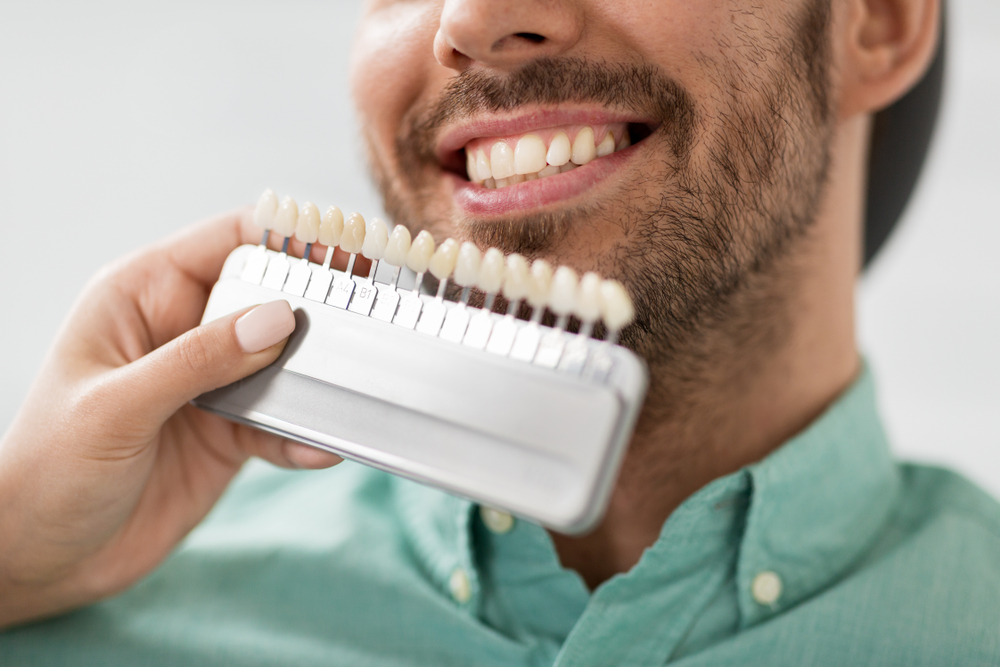
What Are Dental Veneers?
Dental veneers are thin restorations that cover the visible front surfaces of teeth. They can change the color, shape, size, or appearance of individual teeth and are commonly used to address concerns such as:
- Stubborn discoloration that does not respond well to whitening
- Small chips or worn tooth edges
- Uneven or irregularly shaped teeth
- Minor gaps between teeth
- Slight differences in tooth length or proportion
- Certain cases of mild crowding or uneven alignment
Porcelain veneers are commonly chosen because they closely resemble the translucency of natural enamel and are highly resistant to staining. Composite veneers use tooth-colored resin and may offer a different approach depending on your goals and clinical needs. Because the two materials have different advantages and limitations, Dr. Alkebsi will explain which options make sense for your smile.
Veneers are primarily cosmetic. If a tooth is significantly cracked, weakened, decayed, or structurally compromised, another treatment may provide better protection. In those situations, we may discuss restorative dentistry options, such as a crown, rather than covering the front of the tooth with a veneer.
Why Choose Veneers for Your Smile?
One reason patients consider veneers is that they can address several cosmetic concerns with a single coordinated treatment plan. Rather than treating color, shape, spacing, and proportion as completely separate issues, veneers can sometimes improve them all together.
Depending on your needs, veneers may help:
- Brighten teeth with deep or persistent discoloration
- Restore the appearance of chipped or worn edges
- Make uneven teeth appear more symmetrical
- Close selected small spaces between teeth
- Improve the proportions of short or irregularly shaped teeth
- Create a more balanced appearance across the smile
The best veneer results should complement your existing features rather than look artificial or overly uniform. Dr. Alkebsi has a particular interest in cosmetic and aesthetic smile design and emphasizes natural-looking results alongside function and long-term oral health. You can learn more about Dr. Nada Alkebsi and our dental team before your visit.
What Happens During the Veneer Process?
Every veneer case starts with an evaluation. Before planning cosmetic changes, we need to understand the health of the teeth and gums, how your teeth come together, and what you would like to change about your smile.
1. Consultation and Smile Evaluation
Your first appointment is a chance to talk openly about what you like and dislike about your smile. Dr. Alkebsi evaluates your teeth, gums, bite, and overall oral health and discusses whether veneers are appropriate for the changes you want.
Our Bellevue office uses technology, including 3D scanning, digital X-rays, panoramic imaging, and soft-tissue lasers when clinically appropriate. These tools can help us gather detailed information for diagnosis and treatment planning without making technology the focus of your experience.
2. Treatment Planning
We consider tooth color, shape, proportions, alignment, and how the planned changes fit your face and smile. If another cosmetic option is more conservative or better suited to your goals, we will discuss it as well.
For example, whitening may be appropriate when color is the main concern, while alignment treatment may make more sense for certain spacing or positioning problems. Veneers are not automatically the right solution simply because someone wants to change their smile.
3. Tooth Preparation
Some veneers require a small amount of enamel to be removed so the restoration can fit naturally without making the tooth look bulky. The amount of preparation varies depending on the tooth, the veneer material, and the treatment plan.
Because veneers depend on a strong bond to the enamel, preserving healthy tooth structure is an important part of treatment planning.
4. Scans or Impressions
After preparation, we capture the information needed to create veneers that fit your teeth precisely. Our 3D scanner can create detailed digital models that help with planning and fabrication.
Temporary veneers may be used while custom porcelain veneers are being made, depending on the case.
5. Final Placement
Before the veneers are permanently bonded, Dr. Alkebsi evaluates their fit, appearance, and relationship with your bite. Necessary adjustments can be made before or during final placement.
Once bonded, we review how to care for your veneers and may recommend follow-up visits to make sure your bite and restorations remain comfortable.
Am I a Good Candidate for Dental Veneers?
Many adults with healthy teeth and gums may be candidates for veneers, but candidacy depends on more than just the appearance of your smile.
Good candidates generally have enough healthy enamel to support bonding and are free from untreated decay or active gum disease. We also look for conditions that could place excess stress on veneers, including teeth grinding, clenching, or certain bite problems.
Veneers may not be the best first treatment when a tooth is:
- Heavily decayed
- Severely fractured
- Structurally weak
- Affected by active gum disease
- Missing substantial healthy enamel
If we identify an oral health concern first, we will explain what needs attention before cosmetic treatment. Staying current with preventative dental care in Bellevue can also help protect both your natural teeth and cosmetic restorations over time.
Porcelain Veneers vs. Composite Veneers
Porcelain and composite veneers can both alter the appearance of teeth, but they are not identical treatments.
Porcelain veneers are custom-made restorations designed to closely reproduce the appearance of natural enamel. Porcelain is highly stain-resistant and can provide excellent control over color, shape, and proportions.
Composite veneers use tooth-colored resin that is shaped to the tooth. Treatment and repair considerations differ from porcelain, and composite material may be more susceptible to staining and wear over time.
The better choice depends on your teeth, cosmetic goals, budget, desired longevity, and the amount of change you are trying to achieve. A consultation allows us to compare those factors rather than recommending one material for everyone.
How Long Do Veneers Last?
Veneers can last for many years, but their lifespan varies. Material, bite forces, oral hygiene, tooth grinding, diet, and regular dental care can all affect how long a restoration remains in good condition.
Veneers are also not considered a reversible cosmetic treatment when enamel has been removed. Once a prepared tooth has received a veneer, it will generally still require a restoration over the long term.
That is one reason thoughtful treatment planning matters. We want patients to understand both the cosmetic benefits and the long-term commitment before deciding to move forward.
How Do I Take Care of Veneers?
Caring for veneers is similar to caring for natural teeth. The veneer itself cannot develop a cavity, but the underlying and surrounding tooth structure still can.
To help protect your veneers:
- Brush twice daily with a nonabrasive toothpaste
- Floss every day around the gumline and between teeth
- Keep up with professional exams and cleanings
- Avoid chewing ice, pens, fingernails, or other very hard objects
- Do not use your teeth to open packages
- Wear a protective nightguard if one is recommended for grinding or clenching
Routine dental care allows us to monitor your veneers, gum health, bite, and the natural tooth structure around each restoration.
Frequently Asked Questions About Dental Veneers in Bellevue
Do veneers look fake?
Well-planned veneers are designed to look natural. Their color, translucency, shape, size, and proportions can be selected to complement your neighboring teeth and overall smile. The goal is not simply to create the whitest or most perfectly identical teeth possible.
Does getting veneers hurt?
Comfort varies from patient to patient and depends on the level of preparation required. Local anesthetic may be used during tooth preparation, and some patients experience temporary sensitivity afterward. We will explain what to expect based on your specific treatment.
Bellevue Specialized Dental Care emphasizes a calm, patient-centered experience, with comfort-focused amenities and options for patients who feel anxious about dental treatment.
Can veneers fix crooked teeth?
Veneers can sometimes change the appearance of mildly uneven or irregularly positioned teeth, but they do not physically move teeth the way orthodontic treatment does. When alignment is a significant concern, another treatment may be more appropriate.
Can veneers stain?
Porcelain is highly resistant to staining, although the natural teeth around veneers can still change color. Composite resin can be more susceptible to discoloration over time. Good oral hygiene and regular professional care help maintain an even-looking smile.
Can a chipped veneer be repaired?
It depends on the material and extent of the damage. Some minor composite damage may be repairable, while a damaged porcelain veneer may need replacement. If a veneer feels loose, rough, or damaged, contact the office for an evaluation rather than trying to repair it yourself.
How many visits does it take to get veneers?
The timeline depends on the type of veneers, the number of teeth involved, whether preparation is needed, and whether other dental care should be completed first. After examining your teeth and discussing your goals, Dr. Alkebsi can give you a clearer treatment sequence and timeline.
Personalized Cosmetic Dentistry in Bellevue
Choosing veneers is about more than selecting a tooth shade. Cosmetic treatment needs to account for your bite, oral health, facial features, preferences, and expectations.
At Bellevue Specialized Dental Care, Dr. Alkebsi and our team take the time to understand what you want to change before developing a treatment plan. The practice combines modern dental technology with a calm, personalized approach to care.
Our office is located at 3006 Northup Way, Suite 102, Bellevue, WA 98004.
Schedule a Dental Veneers Consultation in Bellevue
If you are considering veneers for stained, chipped, uneven, or irregularly shaped teeth, start with a personalized evaluation. Dr. Nada Alkebsi can examine your smile, explain whether veneers are a good fit, compare appropriate alternatives, and help you understand what treatment would involve before you make a decision.
Contact Bellevue Specialized Dental Care to schedule your dental veneers consultation in Bellevue and take the next step toward a healthy, natural-looking smile.